
For years, people living in the southern fringes of Kolkata places like Joka, Thakurpukur, and the areas stretching toward Diamond Harbour Road, had a common complaint. The distance from the city wasn’t the problem. The commute was.
That’s starting to change
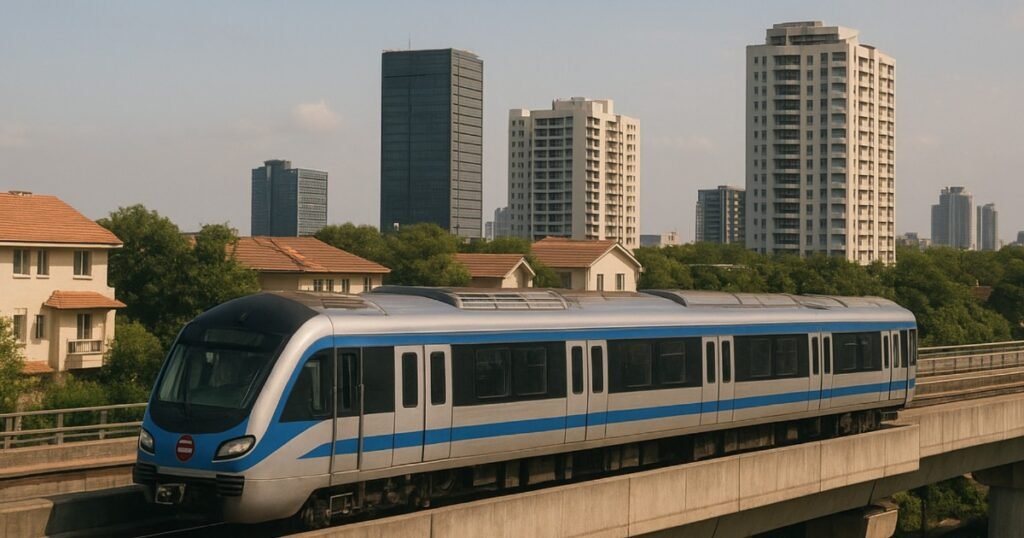
The Joka-Taratala stretch of the metro, part of Kolkata Metro’s Purple Line, has begun altering how people look at this part of the city. Not overnight, of course. Real estate shifts rarely happen that fast. But the early signs are hard to miss.
Property prices are moving. Developers are paying attention. And homebuyers who once ignored the area are now taking a second look.
A Long Awaited Infrastructure Push
The metro expansion connecting Joka to the main urban transit network has been discussed for years. Construction delays, funding issues, and design changes slowed the project more than once.
Still, progress is visible now
Even partial connectivity has started reshaping travel patterns in the southern corridor. For residents who previously depended on crowded buses along Diamond Harbour Road, the metro offers something the area hasn’t had before predictable commute times.
And when commute time drops, property value usually rises. That’s been the pattern in most metro-linked cities.
Kolkata is no exception.
Real Estate Was Already Affordable Here
One reason the metro extension is having such a noticeable impact is simple: prices in Joka and nearby neighborhoods started from a relatively low base.
Compared to central areas like Alipore or New Alipore, property rates along the Joka corridor have historically been far more accessible. That gap is what made developers interested even before the metro line began operating.
Now, the infrastructure story is giving those projects a stronger selling point.
Some residential developments that struggled to attract buyers a few years ago are suddenly seeing renewed interest. Local brokers say site visits have increased—especially from first-time homebuyers looking for larger homes at lower prices.
Buyers Are Thinking Long Term
What’s interesting is that many buyers aren’t just looking at current connectivity. They’re betting on future links.
The Joka corridor is expected to eventually connect deeper into the city’s metro network. If that happens smoothly, commuting toward central Kolkata will become significantly easier.
That expectation alone is influencing purchase decisions.
In real estate, anticipation can sometimes move prices even before infrastructure is fully complete.
And that appears to be happening here.
Developers Are Moving Faster
Drive along Diamond Harbour Road today and you’ll notice something that wasn’t common a decade ago: large residential billboards and construction sites appearing one after another.
Developers see opportunity in transit corridors. It’s a pattern seen across Indian cities—from Bengaluru to Delhi.
When metro lines arrive, residential supply usually follows.
Joka seems to be entering that phase.
Several mid-rise housing projects and gated communities are being planned or expanded in the surrounding areas. Some target middle-income buyers. Others are leaning toward larger homes and villa-style developments.
It’s still early days, though. The market hasn’t overheated yet.
Rental Demand May Follow
Property prices aren’t the only thing that could change.
Rental demand often increases once metro connectivity stabilizes. Students, office workers, and young professionals tend to prefer locations where commuting is easier.
With educational institutions like IIM Calcutta already nearby, improved metro access could gradually increase demand for rental housing in the Joka belt.
Investors have noticed that possibility as well.
Not a Boom At Least Not Yet
Despite the growing buzz, the market hasn’t turned into a full-scale property rush.
Some buyers remain cautious. Infrastructure timelines in India have a habit of stretching longer than expected, and many people prefer to see complete connectivity before committing large investments.
That hesitation is understandable.
But the direction seems clear.
Improved connectivity almost always reshapes real estate markets. Sometimes slowly, sometimes faster than anyone predicted.
For Joka and the surrounding neighborhoods, the metro extension might just be the turning point that changes how the city views this southern corridor.
And if the remaining sections of the line move ahead as planned, today’s “emerging location” could look very different in a few years.